Honoring Women in Olderhood, Receiving Their Authority
It is a pleasure to welcome my good friend Daile Unruh-Peters as guest blogger this month. Daile is a spiritual director, supervisor and an iEnneagram harmony triads facilitator. She has a deep interest in spiritual formation, lifelong becoming, and the particular invitations of olderhood. Daile holds an MA in Christian ministry and brings decades of experience in leadership and accompanying others as they attend to the invitations of God in their lives. Her current work includes spiritual direction and supervision, retreat and formation facilitation, speaking and writing. Her writing focusses increasingly on creating spacious places for women in olderhood. she can be reached at Daile.unruhpeters@gmail.com
For the past fifteen years, I have worked as a spiritual director, supervisor, and retreat facilitator, accompanying people as they attend to God’s formative work in their lives. More recently, my writing has focused particularly on olderhood, the season between sixty and eighty, and on what may be happening spiritually in the lives of women as decades of experience, faith, loss, change, and continuing formation are gathered and integrated.
Across five reflections, I have explored olderhood through the lenses of deepening desire, continuing participation, imago Dei, and the spaciousness that comes as God enlarges our capacity for life, for God, and for one another. I have come to call that inner enlargement capaciousness. Those essays have largely asked what God may still be forming in women as we grow older.
This essay turns the question toward the Church. What happens when the Church encounters women in whom that formation has already borne fruit? Not simply whether women in olderhood still have something to offer, but whether the Church has learned to recognize what God has been patiently forming over an entire lifetime, and whether it is willing to receive it.
Recognition means more than noticing that a woman in olderhood is faithful, wise, or spiritually mature. It means discerning that God may have formed in her something the Church itself needs. Reception goes further. It means allowing her wisdom and spiritual authority to carry weight in the community’s discernment, leadership, teaching, and common life. That may require the Church to examine who it has learned to listen to, whose authority it trusts, and whose voices it has kept at the margins.
My conviction is that the Church needs women in olderhood, not simply because their inclusion is right, but because the Church needs what God has formed in them across a lifetime. It needs their memory, discernment, capacity to hold complexity, perspective shaped through many seasons of urgency and change, and the spiritual authority that can emerge from decades of turning and returning to God. When these women are overlooked, the Church deprives itself of gifts it needs for its own maturity.
Consider Miriam.
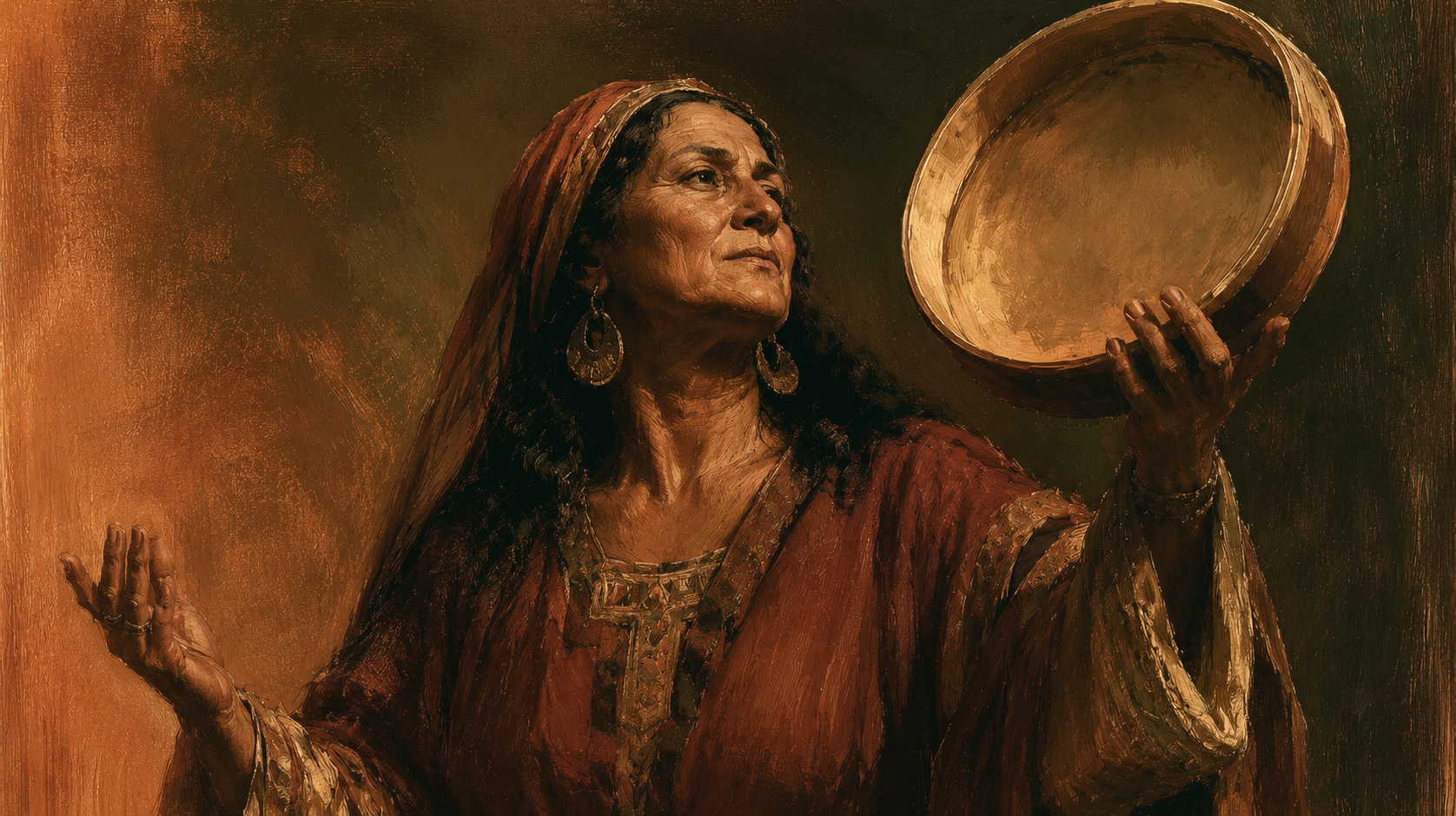
She first appears as a courageous young girl watching over her infant brother on the banks of the Nile. When she re-emerges after the crossing of the sea, she does so as a prophet, taking up the song of Moses and leading the women of Israel in its refrain. In that moment Miriam does more than celebrate deliverance. She helps give communal voice to what Israel has just experienced. God has delivered them, and Miriam helps the people sing that deliverance into memory.
In this sense, Miriam emerges as a keeper of communal memory. Not because Scripture assigns her that title, but because of the place she occupies within Israel’s remembering. She helps the community name and rehearse what God has done; later generations remember her among those God sent to lead Israel; and Israel is explicitly commanded to remember her own complicated story.
Centuries later, Micah 6:4 remembers Israel’s leadership in strikingly inclusive terms: “I sent before you Moses, Aaron, and Miriam.” Miriam is not incidental to Israel’s story. She belongs to the remembered leadership of the people of God. Deuteronomy goes further, commanding Israel, “Remember what the Lord your God did to Miriam on the way when you came out of Egypt” (Deut. 24:9).
And what Israel remembers is complicated. The command reaches back to Numbers 12, to Miriam’s challenge to Moses, her exclusion from the camp, and her restoration. Scripture does not preserve a sanitized Miriam. It remembers prophet and challenger, leader and chastened woman. Yet even here, Miriam’s significance to the community is visible: “the people did not set out on the march until Miriam had been brought in again” (Num. 12:15). Israel waits for her. The journey of the community does not continue without her.
Miriam therefore both carries memory and becomes part of the memory Israel carries. In Scripture, remembrance is never merely mental. The Hebrew biblical notion of remembering, zakar, is active, communal, and covenantal. To remember is to hold the truth of God’s action before the people in ways that can reorient their life together.
Growing older is inevitable; becoming enlarged by grace is not. Chronology is not the same as formation, and longevity alone does not confer authority or holiness. Recognition therefore requires discernment. The Church must learn to perceive the Spirit’s fruit, not simply assume it.
At their best, the lives of women in olderhood bear witness not merely to experience accumulated over time, but to lived metanoia: decades of reorientation, turning, and return toward God. Their authority does not rest in flawlessness, position, or visibility. It is born through participation in the life of God across years of faithfulness, failure, forgiveness, relinquishment, beginning again, and hope.
Miriam therefore offers more than an example of a woman who exercised authority in the biblical story. She offers a lens through which to consider the life of the Church itself. Who carries the Church’s memory now? Who remembers what God has done, where the community has failed, what it has learned, and where grace has met it along the way? And what happens to a community when it stops listening to the women who have lived long enough to remember?
This is one reason women in olderhood matter so deeply. The Church has not simply overlooked women. Across much of its history, it has silenced them, restricted their authority, excluded them from leadership, distrusted their theological voices, and taught them, explicitly or implicitly, to defer to the spiritual authority of men. This has happened despite a biblical narrative in which women speak prophetically, lead, teach, bear witness, exercise wisdom, and participate in the purposes of God, and despite the example of Jesus, who received women as disciples, engaged them as theological conversation partners, defended their dignity, entrusted them with revelation, and sent them as witnesses.
For many believing women, marginalization is therefore not an isolated experience or a historical abstraction. It has been woven into their experience of the Church. Women have learned to love and serve communities that have not always trusted their voices. They have remained faithful within traditions that have limited the ways their gifts could be expressed. Some have internalized those limits so deeply that recovering their own spiritual agency becomes part of the work of formation itself.
Even churches that believe they have resolved this problem theologically may still reproduce it through habit, culture, and informal patterns of trust. A stated commitment to the equality of women and men does not necessarily mean that a church has examined the habits, structures, assumptions, and informal practices through which authority is actually exercised. Women may be told that every role is open to them while continuing to discover that men are more readily trusted, heard, invited, mentored, platformed, or assumed to carry spiritual authority. The result can be stated egalitarianism alongside practiced complementarianism.
For women who have lived for decades within that contradiction, the cost is significant. When a church’s practices contradict its theology, it diminishes the women within it and compromises its own vocation to form a people whose common life bears witness to the way of Jesus. The appropriate response is not simply greater awareness or better representation, but repentance and renewal: the willingness to name what has been distorted, turn from it, and allow the Spirit to reshape the Church’s common life.
And then age enters the story. Olderhood does not erase the history these women carry; it adds another layer to it. The same women whose voices may have been constrained, discounted, or left at the margins because they were women now encounter the cultural and ecclesial diminishment associated with becoming older.
The irony is profound. Precisely as decades of life with God may be producing greater integration, freedom, discernment, and spiritual authority, these women may become less visible to the Church. The woman whose voice was constrained because she was a woman may now discover that she is also less likely to be heard because she is old. The Church may expect less of her, listen less carefully, or assume that her most significant contribution lies behind her.
That failure is not incidental. It is revealing.
We have built church cultures trained to recognize particular forms of authority. We know how to notice platform, position, charisma, productivity, visibility, and influence. We know how to celebrate what can be seen, measured, and multiplied. But the authority formed through decades of surrender, reorientation, failure, forgiveness, courage, and return to God rarely announces itself in those terms.
Churches often know how to honor women in olderhood sentimentally without receiving them structurally, thanking them, admiring them, even depending on them, while leaving untouched the patterns of authority and discernment that keep their wisdom at the margins. These women may be relied upon to pray, mentor, visit, host, organize, and steady the life of a congregation, while rarely being asked to shape its vision, interpret its conflicts, teach with authority, or help guide its deepest discernments and most consequential decisions. A church may praise a woman’s faithfulness while remaining uninterested in being taught, corrected, enlarged, or changed by what her life has come to know.
This is not simply a matter of fairness, representation, or inclusion, though it certainly touches all three. It is a matter of the Church’s own maturity. More particularly, it is an ecclesiological matter. A community that cannot receive what God has patiently formed over decades impoverishes itself.
These women may carry a steadiness, freedom, discernment, memory, and depth of perception formed through sustained participation in the life of God. They remind the Church that spiritual authority is not primarily a function of office, platform, charisma, speed, or influence. It carries a different kind of weight: the credibility of a life made increasingly truthful, spacious, and free in God.
If women in olderhood have been invited to desire more deeply, to live fully, to inhabit the imago Dei more freely, and to become spacious through grace, then the Church must become spacious enough to receive who they have become.
Here the invitation becomes an indictment of the Church’s habits.
If the Spirit has spent decades cultivating wisdom, discernment, steadiness, spiritual freedom, and capaciousness in women whom the Church continues to overlook, then the problem does not lie in the absence of gifts. It lies in the Church’s failures of recognition and reception, and in its resistance to the enlargement true reception would require.
The Church needs what formation across a lifetime can yield: memory tested by time, discernment refined through surrender, and authority that has ripened in the presence of God.
Nor can the Church assume it can postpone receiving this gift indefinitely. Olderhood has a horizon. The women carrying sixty, seventy, or eighty years of lived memory and the slow, hard work of spiritual formation will not always be among us. Their passing will mean the loss of particular witnesses to God’s faithfulness, people who remember what the community itself may have forgotten, and whose lives carry knowledge that cannot simply be reconstructed later.
Their authority does not lie in having lived flawlessly. It lies, when grace has done its enlarging work, in having continued to turn toward God and become more capacious.
The keepers of memory are still among us.
Making room for that memory and authority must become visible in the Church’s actual life together: in who is invited to speak into discernment, whose wisdom is sought when a congregation faces conflict or change, who is trusted to teach, to name what is true, to notice what others have missed, and to help a community remember God rightly. If women in olderhood are welcomed warmly but rarely asked to shape the Church’s judgments, practices, or imagination, then honor has stopped short of reception.
The question is whether the Church will recognize what God has formed in them, receive what the Spirit has given through them, allow that gift to participate in her own conversion. The Church’s future may depend, in part, on whether it can learn to see those it has trained itself to overlook, while there is still time to listen.
Reflection Questions
Where does your church honor women in olderhood without actually receiving their spiritual authority?
What would need to change for the wisdom and spiritual authority of women in olderhood to shape the discerning life of your church?
Where might your church be called to repentance and renewal in the ways it listens to, trusts, and receives women?
A Note on Language
Although Christian tradition often refers to the Church as she, I generally use it here when speaking of the Church corporately and institutionally. In an essay addressing the Church’s treatment of women, consistently feminizing the institution risks obscuring the very dynamics being examined. Any use of feminine language is therefore intentional rather than assumed.
For Further Reading
Denise Taylor. ThriveSpan: Walking Gently Into What Matters Now. Brook House Press, 2026.
Joan Chittister. The Gift of Years: Growing Older Gracefully. New York: BlueBridge, 2008.
Wilda C. Gafney. Daughters of Miriam: Women Prophets in Ancient Israel. Minneapolis: Fortress Press, 2008.