All Bible translations carry bias. Whether correct or incorrect - biases there are to be sure. Starting from the more obvious, skewed and extreme biases of translations like the Scofield reference Bible to its “cousin”, the Darby Bible with an extreme literal style, poor use of critical Greek texts, and translation choices shaped by Darby’s own theological framework. Through far more nuanced choices in translation like gender neutral language in obviously gender-neutral texts. Every Bible translation carries its own set of assumptions, and no translator comes to the text fully neutral. Like anyone else, I carry my own set of preferences and biases, even if I happen to believe they are the right biases.
Recently, and of concern in charismatic circles, the TPT (The Passion Translation) is widely criticized for taking liberties in adding interpretive and emotive language not found in the original manuscripts. Most scholars classify it as a poor paraphrase, rather than a reliable Bible translation. Paraphrase has its place, if the paraphrase is named as such, and if the user has sufficient understanding that these are not translations to do Greek and Hebrew word studies or base doctrinal teaching from.
Doctrinal teaching now, of course, being about as popular as leprosy. But, like it or not, the essentials of our faith remain the essentials of our faith. Please feel free to question them. Remain curious about them. Deconstruct them and reconstruct them as a task under the guidance of the Holy Spirit, if you must. But do be faithful to as much faith as you have been given to be faithful to. Faith is not about the absence of doubt. It is about faithfulness to whatever faith each of us has been given.
After all, it is the Scriptures themselves that introduce us to and teach us about Jesus. It is more than contradictory that so many who love him, do not want to delve deeply into the very Scriptures that teach us most of what we know about him. I have an unashamedly high view of Scripture but a much lower view of many interpretations of that same Scripture.
A few years back, a senior leader in the Church circles I move in asked me why I was preaching through the book of Romans at my local church. He expressed significant reservations around expository preaching of any kind. I responded that in my case it was time - in the sense that I felt I finally had sufficient theological chops to preach it. And, I added that I did not want any congregation under my spiritual care to be biblically illiterate. We live in an age, where too many followers of Jesus fall into that category.
As a local pastor I have been frustrated at times at how little seems to be understood by even leaders in the Church, about the Bible and indeed, the process of Bible translation. This has led to all sorts of badly skewed and even conspiratorial beliefs ranging from the KJV “as the only reliable version” sect, through to those believing that NIV has “intentionally omitted texts that have always been there” to lead people away from faith in Jesus and toward some imagined and unholy agenda. Neither of the statements regarding the KJV or NIV are remotely based in fact.
Bearing this in mind, the blog offers a short, and extremely basic, word on Bible translation, using gender- and gender-neutral language, where gender inclusivity is intended, as the case study. Following this short offering, my good friend Daile Unruh Peters will offer perspective on the use of language relating to God, from a woman in Olderhood.
*Disclaimer: My proficiency in Koine Greek is useable - barely. My Hebrew (the bit that once existed) is now non-existent apart from scattered words and streams of consciousness😊. I have no excuse really since I have a friend, David Clemens, in our Church, who is a language scholar of some note. It is my intention eventually to go a little deeper here with David.
My own first shift toward more gender inclusive language was around the year 2000, when I started using “humanity” rather than “man” when speaking of humankind collectively. It seriously was not any kind of “slippery slope” that led me away from faith in Jesus. It was a recognition that there are (still) deep prejudices and patriarchy at play in various places of significant influence that Jesus – the same Jesus who preached that Sermon on the Mount, would like us to address and change.
Gender considerations in Bible translation
Bible translation and gender, centres on how translators balance faithfulness to ancient, gendered language with clarity for modern readers. In this process translators must navigate linguistic, theological, and cultural debates about inclusivity and meaning.
The Core Issue: Gendered Language in Ancient Texts
Biblical Hebrew and Koine Greek use grammatical gender extensively, often employing masculine forms as generic references to mixed groups or to humanity, as a whole.
Terms like the Hebrew ’ādām and Greek anthrōpos can mean “man”, as in the male of the species, or more generally, “human being,” depending on the context. Translators must decide whether to preserve these masculine forms or render them inclusively when the original intent appears to be broad. For example, Genesis 1:27 uses ’ādām to refer to humankind, yet later uses the same term for an individual male. It is down to translators to determine when which is which. Similarly, Greek anthrōpos in 1 Timothy 2:4 is widely translated as “people” rather than “men” to reflect its inclusive meaning.
Translation Theory and Its Impact: Translations matter
Two major translation philosophies shape gender decisions:
• Formal equivalence aims to preserve original grammatical forms, including masculine generics. Translations like the ESV or KJV often retain “man,” “sons,” or “brothers” even when the context rather clearly suggests mixed audiences. I tend not to use these translations as primary text to preach from, although I might reference them as illustration, where and when I think they have translated well, or poorly.
• Dynamic equivalence prioritizes conveying meaning in contemporary idiom, leading to renderings such as “people,” “brothers and sisters,” “humanity” or “humankind.” The NRSV and NIV 2011 adopt this approach more frequently. The core commitment is to holding faithfulness to the original language whilst making that language contextually relevant to our culture.
These choices are not merely stylistic. Shifting, for example, from singular masculine pronouns (“he”) to plurals (“they”) or second person (“you”) subtly changes emphasis and interpretive nuance. Critics argue that such changes risk obscuring male-representative patterns present in the original languages, while supporters, of whom – if you had not yet noticed - I am one, contend, that they better reflect the intended scope of the text.
Theological and Cultural Debates
Gender in translation is deeply intertwined with theological concerns. My own go-to scholars would argue that inclusive language better reflects the Bible’s own broad rhetorical intent and avoids reinforcing patriarchal assumptions not inherent in the text. Others maintain that altering gendered terms introduces interpretive bias, potentially muting theological themes tied to male representation, such as covenantal sonship or Christ’s incarnation as a male. I would argue that Christ’s incarnation had everything to do with his humanity and significantly less, if anything apart from cultural appropriateness, to do with his being male.
The Wartburg Project resulting in the EHV, emphasizes that accuracy to the inspired text must outweigh contemporary linguistic trends, warning that adopting gender-neutral language where the original is gendered can blur biblical teachings on marriage, creation, and gender roles. Their assumptions are complementarian. Conversely, organizations like CBE International argue that many traditional translations have distorted passages and even, in one instance, names (Junias rather than the correct feminine form Junia) in ways that devalue women – sometimes by translator design. They advocate for gender accurate renderings that reflect shared human dignity and participation - I concur.
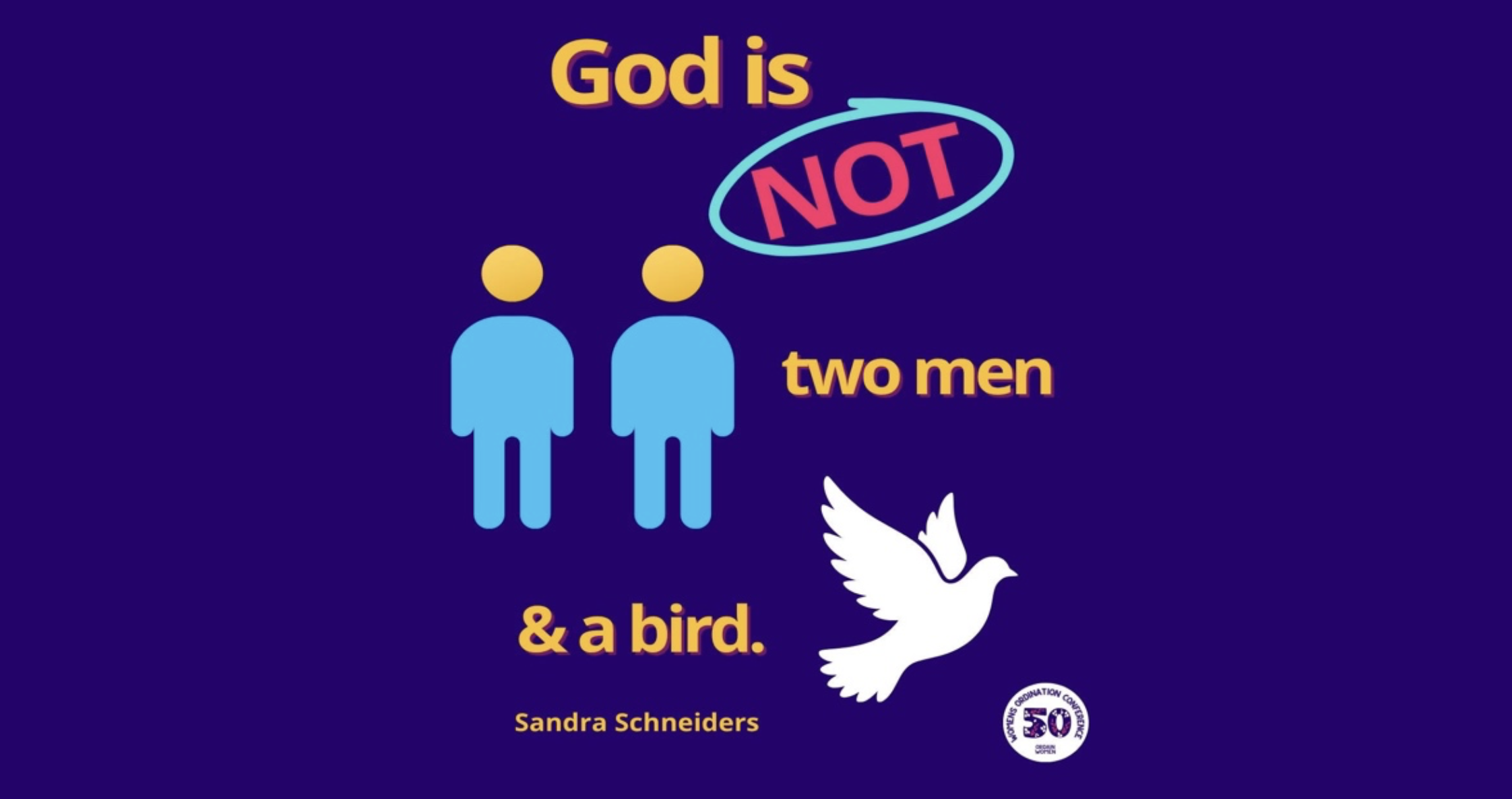
The graphic bears the Women’s Ordination Conference logo in the lower-right corner, so that is the apparent source of the design. I couldn’t locate the exact original post or its publication date. The exact sentence, “God is not two men and a bird,” is attributed to Sandra Schneiders in Katie Lacz, “Our Relational, Three-in-One God,” Ignatian Solidarity Network, June 5, 2023.
Women’s Ordination Conference (undated); quotation attributed to Sandra M. Schneiders, I.H.M.
Historical and Scholarly Perspectives
Historical translations - from the Septuagint to the Vulgate to early English Bibles - generally preserved masculine generics because they reflected both the source languages and the norms of their eras. They do not represent the norms of our era.
Modern scholarship increasingly examines how translation choices shape gender construction. Studies of Genesis across Hebrew, Greek, and Latin show how subtle shifts in vocabulary can reinforce or soften hierarchical gender patterns. Contemporary research also critiques androcentric assumptions embedded in traditional renderings and proposes guidelines for gender accurate translation that avoid both ideological rewriting and unexamined bias.
Contemporary Approaches
Our contemporary translations fall along a spectrum:
• Conservative formal equivalence versions (ESV, CSB) retain most masculine generics.
• Moderate dynamic equivalence versions (NIV 2011) use inclusive language where context supports it. This is my current go to when preaching or doing study.
• Fully gender inclusive projects (NRSV, CBE’s forthcoming translation) aim to reflect inclusivity consistently across Scripture.
For language relating to God, over to Daile.
Perspective: Language Matters – Daile Unruh Peters
Melt observes that choices about language are not merely stylistic. I want to follow that concern into another part of our life of faith: how the language we use for God shapes our imagination, our worship, and our sense of belonging. For me, this question names a quiet weight I have carried for years: the ongoing work of locating myself, as a woman, within a predominantly male language and conceptualization of God.
In my faith contexts, God is most often spoken of as Father, He, Him. I have learned to adapt my imagination and my prayers and trust that God is far larger than these words, even as those same words quietly narrow who God is and how God is known. Over the years, this adaptation has become heavy lifting. Rarely named, it nevertheless requires attentiveness and spiritual energy, an effort to remain faithful to a God who is not male or female, but wholly and mysteriously God.
Language is never neutral. The words we use shape not only what we think, but how we imagine, how we pray, and how we understand our place before God. Over time, repeated language forms the contours of belief. It influences what feels natural, what feels authoritative, and what feels possible in our relationship with the Divine.
For many Christians, referring to God as Father and using male pronouns is deeply familiar and meaningful. This language is biblically grounded and rooted in tradition, and I am not suggesting it be eradicated or rejected. Jesus himself taught his disciples to pray “Our Father,” and Scripture offers powerful paternal metaphors for God’s care, authority, and faithfulness. But receiving this language as a gift is different from treating it as the only faithful way to address God.
When we rely almost exclusively on male language for God, something subtle happens. God begins to sound male. Authority begins to sound male. Leadership and holiness quietly take on a masculine register.
This language permeates the songs we sing, the sermons we hear, the art we display, the theology we teach, and the stories through which children first imagine God. If we repeatedly represent divine wisdom and authority in masculine terms, what are we teaching a girl about the relationship between her humanity and the God whose image she bears? What possibilities might a woman struggle to recognize in herself when the language of holiness so rarely sounds like her life?
Melt distinguishes between a high regard for Scripture and confidence in our interpretations of it. That distinction matters here, too: Scripture offers a greater breadth of imagery for God than our customary language often allows. In Isaiah, God is likened to a woman in labour, a nursing mother, and a mother comforting her child (Isaiah 42:14; 49:15; 66:13). Deuteronomy speaks of God giving birth (32:18). Elsewhere we encounter fire, rock, refuge, and light. These images open different ways of attending to God’s presence and character.
The Hebrew Scriptures offer names and titles such as YHWH, Elohim (God), Adonai (Lord), and El Elyon (God Most High); the Greek New Testament uses Theos (God), Kyrios (Lord), and Patēr (Father), among others. Together with Scripture’s many images, these names invite us into an understanding of God that continues to deepen.
The invitation I perceive is to “degender” our understanding of God. By “degendering,” I mean releasing our language and imagination from the requirement that God be identified as male. This includes choosing “God” rather than automatically using “He,” and welcoming biblical images drawn from women’s bodies and experience alongside other ways of naming the Divine. It means allowing each image to offer its insight without requiring it to contain God. Neither “Father” nor “Mother,” nor even all our names together, exhausts the fullness of the mystery of the One we seek.
There is also a deeper theological concern at stake. When we reduce God to a single, fixed image, even a cherished one, we risk moving toward idolatry. Idolatry is not only about worshipping false gods; it is also about forming God in an image small enough for us to manage, explain, or control. When we choose a name for God and defend it against every other image, we can make an idol of our own understanding. The name that once helped us encounter God becomes a boundary we refuse to let God exceed.
This is why I believe we must stop reducing God. To insist on a smaller account of God when Scripture offers such abundance is a serious spiritual loss. I often wonder: how willing are we to let our understanding enlarge?
Sometimes the shift begins with something as simple as how we speak. Instead of saying, “He walks with us through suffering; His love is constant,” we can address God directly: “You walk with us through suffering. Your love is constant.” Or we might pray, “Faithful God, walk with us through this uncertainty. Help us recognize your presence and receive your love.” We can speak intimately with God without continually supplying a masculine identity.
We might also turn to El Roi, the name Hagar gives God following her encounter with the angel of the Lord in the wilderness, commonly rendered “the God who sees me” (Genesis 16:13). A woman who feels overlooked or unheard might pray, “God who sees me, I bring you what I have struggled to say aloud.” Attending to this name may help her become more honest about her experience and more receptive to being known by God. Hagar’s testimony also gives her a woman’s encounter with God to accompany her own.
Or we might pray with Isaiah’s image of God as a mother comforting her child (Isaiah 66:13). In a season of grief or exhaustion, we might say, “Mothering God, I am weary of holding everything together. Let me receive your comfort and rest in your care.” This image may give us room to bring vulnerability into prayer and to imagine divine strength expressed through a mother’s presence and tenderness. For a woman accustomed to caring for others, it may also open the possibility of allowing herself to be held.
Men, too, have something to receive in this enlarging. A man who has learned to associate strength with control or self-sufficiency may discover, in God’s maternal tenderness, greater freedom to grieve, express affection, acknowledge dependence, or receive care. He might pray, “Mothering God, I do not know how to let myself be comforted. Help me bring you the sorrow I have kept hidden.” Receiving women’s testimony and Scripture’s maternal imagery can enlarge the emotional and spiritual life available to men as well, making room for ways of loving, trusting, and being known that a narrow account of masculinity may have discouraged.
But changing pronouns alone will not complete this work. We can say “God” while continuing to imagine a male figure whose authority is reflected most fully in men. The invitation reaches into how we study Scripture, whose testimony we trust, how we recognize wisdom, and whether women’s encounters with God can help form the community’s understanding. Churches share responsibility for making that space in their teaching and common life. Women should be able to approach, relate to, and worship God fully, with their humanity welcomed as bearing the divine image.
For some, this way of speaking may feel unfamiliar at first. We can attend honestly to that unfamiliarity. What do I fear losing if I loosen my hold on a familiar name? What might I discover about God through an image I have rarely been invited to receive? What might enlarge in me in response to a larger understanding of God? These questions belong within a life of faith that remains open to being taught.
I long for women to bring their whole selves into relationship with God: their intelligence, embodied experience, affection, questions, grief, delight, and capacity for worship. I long for our churches to speak in ways that welcome that fullness. And I long for us all to discover more of God than we have yet known.
We can love the names that have sustained us while acknowledging that God exceeds them. We can let those names lead us further into mystery, rather than defend them as the limits of what may be known. The idolatry of reducing God asks us to protect the boundaries of our understanding. Faith invites us to open ourselves to the vastness of God.