Dealing with Crisis and Loss
Christmas season is a challenging time for many. It’s a lovely time for some. It’s a significant spiritual celebration for most who are on the Way. But it is a difficult and lonely time for so many people in the world. I’ve been preaching on crisis and healing over the past while. Christmas comes as a historical crisis time to some. A season that comes upon them as a historical and annually lived, mini-crisis.
This month’s blog is more sermonic than usual.
Human existence is oftentimes about dealing with crisis and loss. If you’ve not yet realized it, following Jesus is not a detour around crisis, loss and suffering. Jesus gives us the wherewithal to cope with crisis and loss and on occasion, in certain specific circumstances there might indeed be supernatural protection for us from some specific crises, but in general there is little that besets every human on the planet from which we are somehow miraculously protected. I mean, we all have motor vehicle insurance, right?
Crisis? What crisis?
Let’s talk about a thing called crisis. Jesus wants to deal with the crises and loss in our lives. And we all have crises to deal with. Age and gender and whatever other differences we might have, do not surpass the issues common to us all, life and human struggle.
Broadly speaking, there are three types of crises we might face. The first one is a crisis that is caused by an event. There is no planning for it. Aside from insurance on your home, or car, or health, there is little you can do about natural disaster, or a motor vehicle accident, or sudden debilitating illness, or anything else of that nature.
When we lost our home in 2019 to wind driven fires raging through the small coastal village in the Western Cape of South Africa where it was located, it was an event that we really could do nothing about. Wind speeds driving the fire were estimated up to one hundred and fifty kilometers per hour. When a wall of fire approaches at that speed there is nothing to do other than pray and leave…as quickly as possible.
The second type of crisis we might face is more of a historical type of crisis. A problem that just seems to go on and on and on. Substance abuse in the family, hereditary disease, addictive behavioral patterns passed down from one generation to the next, the poverty cycle and financial struggle. Broken relationships within the family, habitual marital unfaithfulness, – that sort of thing. “That thing that just won’t go away.” A problem that has long history attached to it.
The third crisis everyone will face somewhere in their life is an existential crisis. The “what’s it all about” crisis. The postmodern person often lives in a state of perpetual existential crisis. It’s a faith crisis. These crises of existence raise their heads at various times of our lives. Two of the most likely times that existential crisis will arise, are during adolescence and again during midlife. All these crises exist and are a real part of just being alive. But crisis is not a modern phenomenon. These things have always existed. For our purposes we are going to consider some of the crises Jesus addresses in the New Testament.
In the Gospel of John, the Pharisee Nicodemus comes to Jesus at night. “Rabbi, we know that you are a teacher who comes from God…(Jn 3:2)” What is he asking? Well, he’s asking questions relating to the meaning of life. The good Pharisee wants to know. Am I on the right path, Lord? The same applies to the rich young ruler. “Lord, what do I need to do to inherit eternal life? (Lk 18:18)” Help me here Jesus, ‘am I faced in the right direction?’ These are existential or faith crises.

There are also historical crises in scripture. The prodigal son. The woman at the well in John 4. She is caught up in a behavioral pattern that has been going on and on. “Sir, give me this water so that I won’t get thirsty (Jn 4:15)”. The fact that these crises occur in the Bible tells us that a part of the experience of being human is to do with the effects of sin, and to do with pain, and to do with suffering. Clearly, crisis transcend the times in which we happen to live.
All of us, from the beginning of time are broken creatures, and the healing of that broken Imago Dei, (image of God) in humanity is part of redeeming a lost humanity for God. In life then –in biblical times, and our times now, we see that a major part of living life is to do with coping around crisis and suffering.
The Gospel message that says “Come to Jesus and all of your problems will be over” is an incorrect message. Your life will have meaning, yes. Your life will be a life of purpose and substance, yes. But the promise is not one of an easy life – it never has been, and it never will be…We will walk the road to Calvary before we taste the glory of the resurrection.
There are certain things – even in the faith – that one never ‘gets over.’ We learn to cope, and we learn to reconstruct around the loss that accompanied the crisis. Crisis always involves loss of some sort and crisis always carries with it ongoing pain. And the pain that we live with is often because of the years that have been lost because of these crises.
When Jesus deals with people in the NT, he addresses every aspect of their pain. He doesn’t only deal with the stronghold. I.e., the manifestation of the sin, which can be seen in behaviour. Things like sexual promiscuity or sexual perversion, alcohol or drug dependence and so on. He doesn’t only deal with the stronghold; he deals with the bondage that underlies the stronghold. Things like bitterness, unforgiveness, a critical spirit, a perpetually negative posture, gossip, meanness, an ungenerous spirit, jealousy and so on. Jesus wants to deal with all our sin, all our brokenness and all our pain.
With this as a background, let’s look at one NT story of Jesus interacting and healing a broken person.
Mark Chapter 5:24b-34 24 So Jesus went with him. A large crowd followed and pressed around him. 25 And a woman was there who had been subject to bleeding for twelve years. 26 She had suffered a great deal under the care of many doctors and had spent all she had, yet instead of getting better she grew worse. 27 When she heard about Jesus, she came up behind him in the crowd and touched his cloak, 28 because she thought, “If I just touch his clothes, I will be healed.” 29 Immediately her bleeding stopped, and she felt in her body that she was freed from her suffering.
30 At once Jesus realized that power had gone out from him. He turned around in the crowd and asked, “Who touched my clothes?”31 “You see the people crowding against you,” his disciples answered, “and yet you can ask, ‘Who touched me?’ ”32 But Jesus kept looking around to see who had done it. 33 Then the woman, knowing what had happened to her, came and fell at his feet and, trembling with fear, told him the whole truth. 34 He said to her, “Daughter, your faith has healed you. Go in peace and be freed from your suffering.”

This woman had a terminal illness. At least two types of the three crises we identified can be seen in her life. The event of the onset of the disease itself, and then twelve years into it, it has become a crisis with significant history attached to it. This thing had just been going on and on and on and she was not getting any better. For twelve years she had been seeing every doctor, every physician and every quack who promised healing, and as a result she was bankrupt. She had lost every material thing she had. And more than the material loss she suffered, her condition continued to deteriorate.
Whatever this menstrual or uterine problem was, it just wouldn’t go away. For some of us there is an illness, or a condition in our life, that just doesn’t seem to go away. A situation of historical crisis.
Her Loss
Let's consider the woman's loss. Her most obvious loss is loss of health. In verse 28 she says, “If I just...or if only I...” An “if only” statement is always indicative of hopelessness. She has lost all but a scrap of hope.
The fact that the sickness this woman had, was to do with the most vulnerable and intimate part of her body, meant that she had most definitely lost dignity. Particularly given the OT hygiene laws that were so strictly adhered to at that time.
Verse 26 tells us that she had spent everything that she had. She had also experienced a loss of income. Wealth and income are different from one another. She lost what she had, but she also lost the ability to replenish her loss. Looking to verse 28 again, we see the desperation in the woman’s statement that: “If I just touch his clothes...” Loss of all confidence.
To really understand the extent of her loss, we need to go to Leviticus 15. Leviticus 15:25 says this: “When a woman has a discharge of blood for many days at a time, other than her monthly period, or has a discharge that continues beyond her period, she will be unclean as long as she has the discharge...”
In fact, her reality goes beyond this verse. Anything she touched would be declared unclean. And anyone who touched her or anything that she had touched would be declared unclean. Anyone who sat where she had sat would be declared unclean.
Can we begin to understand the loss that she faced? Total rejection by the community of which she was a part. No one would go near her. No one would touch her for fear of being declared unclean themselves. For twelve years she lived like this. Completely ostracized by everyone. Total loss of companionship and fellowship. And everyone in the community is talking about her, because that’s the way it works.
And she is making the Kingdom break through violently, because she pushes, and touches and disregards her way forward to get to Messiah, to get to her healing. She is violently, desperately, breaking every taboo, every cleanliness ritual and every law in her pursuit of healing.
And the most amazing part of the story is to be found in this statement: “If I just touch his clothes, I will be healed.” Immediately her bleeding stopped, and she felt in her body that she was freed from her suffering.” In Jesus, heaven comes.
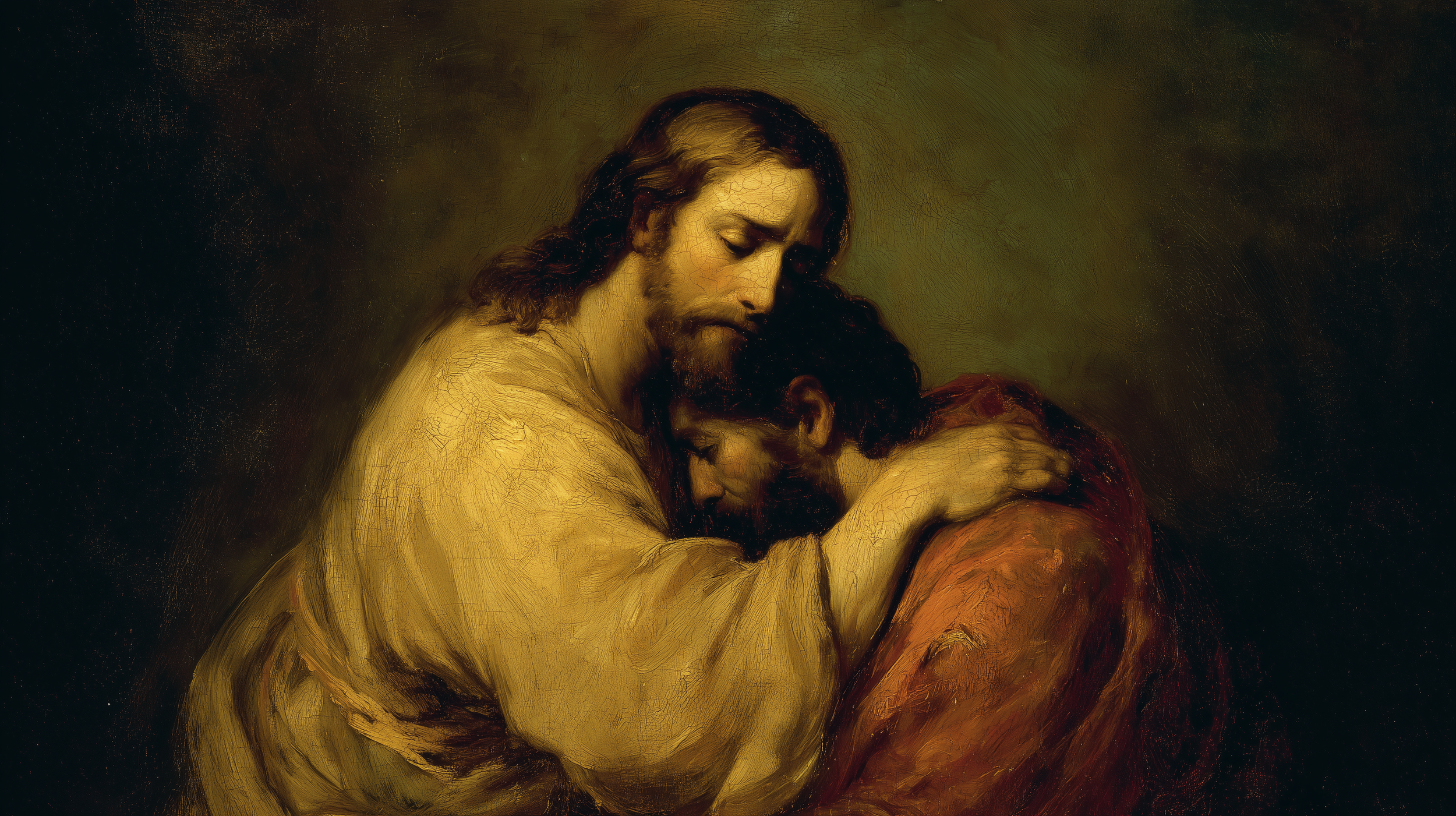
A dramatic physical healing. The physical healing is only the healing of one dimension of her suffering. Jesus, because He knows the heart of the woman stops and says: “Who touched my clothes.” Why does Jesus ask this? Because Jesus knows that for full healing to take place the loss that she suffered needs to be reinstated. He wants to set her free from everything that holds her captive, everything that holds her in bondage. Remember, she has lost her dignity, her family, her home, her income, her place in the community, her confidence, all human touch, her companionship, and her hope. And Jesus wants to restore that all to her.
Jesus wants to restore everything to us this Advent.
He wants to do that because He loves us, and He values us. Jesus stops and pays attention to her. And of course, when he pays attention to her, the attention of the community, for the first time in twelve years is focused squarely on her. And the focus needs to be on her if she is to be restored and reinstated to the community. Jesus needs to let the community know that this woman is very important to him. She hides from Jesus, but he pursues her with the love of God. Verse 32: “But Jesus kept looking around to see who had done it.”
Jesus is searching
The wonder of the healing of Jesus is that He is searching. And in this story, Jesus finds her, and she comes to Him and stands before Him humbly and almost apologetically. And He lifts her up and he calls her by a very special name. “Daughter.” “My child.” I.e., “You are beloved, and you are a part of a family.” Reinstatement. This all happens in a crowd. “My child.” And as Jesus keeps looking for her and begins to restore and to reinstate her, she begins to feel that old identity that she used to have before the onset of the bleeding disorder is slowly starting to return.
The physical healing is one dimension, but the full restoring illustrates the extent of the miracle here. From now on this woman would always be known as the one whom Jesus had healed and who he called: "My daughter.” Companionship is restored, fellowship is restored, public worship is restored, confidence is restored, integrity is restored, affection is restored, hope is restored, holiness and purity are restored, health is restored, and freedom is restored. And that is the full extent of what this story is about.
And then finally, almost as the crowning glory of all this Jesus says to her that there is something in you that is very special to me and that is your faith. “...your faith has healed you. Go in peace and be free from your suffering.” The first level of our own freedom is about us responding to Jesus. Our belief can be turned to faith. Jesus wants us to respond to Him. He is looking for us and He wants us to be restored to Him.
The second level of healing might be this; despite your circumstances, hold onto Him, do not let Him go. He notices, He sees. And ultimately your faith will make you whole. Jesus is still in the business of dealing with the crises in our lives. He has not changed in 2000 years, and He never will. Make a faith response to Him and trust Him for healing.
Merry Christmas.